An e-ticket generator creates digital tickets and sends them via email, SMS, or WhatsApp.
Most e-tickets use a unique QR Code which allows fast scanning and flags duplicate entries.
Digital tickets reduce lost tickets, printing work, and fake entry attempts.
The most effective setup is simple: event page → ticket design → auto-send → QR scan check-in → attendance report.
Picture this: you’re planning an event. Printing paper tickets already feels like work. They get lost. They get copied. They get damaged. And at the gate, even one small mistake can result in long queues.
That’s why more events are switching to an electronic ticketing system. With today’s online ticketing systems, sending tickets to your guests is almost effortless. No envelopes, no printers, no clutter, just a quick message to their phone or email.
“One-time entry tickets lock after the first valid scan, preventing duplicates or forwarded screenshots.”
This guide breaks down what an e ticket generator does, how electronic ticketing works, and how to set it up so check-in stays smooth, whether you’re hosting a small gathering or a packed event.
A. Understanding the Electronic Ticketing System
1. What is an e-ticket generator?
An e-ticket generator is a tool that lets event organizers create digital tickets and send them to guests online instead of printing paper tickets.
With an e-ticket generator, tickets are created digitally and delivered by email, SMS, or WhatsApp. Guests simply show the ticket on their phone at the event.
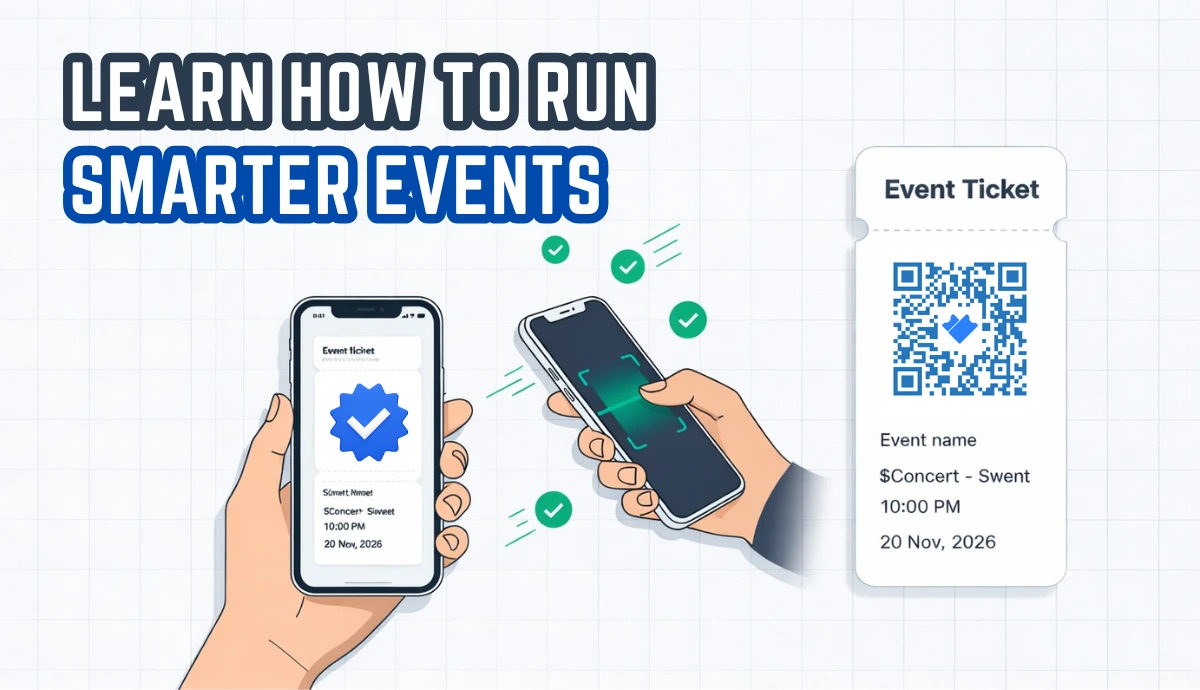
Each electronic ticket includes a unique QR Code or barcode. When scanned at entry, the system checks if the ticket is valid and whether it has already been used.
Ticket creation: The organizer uses an e-ticket generator to create tickets for the event.
Ticket delivery: Tickets are sent automatically to guests after registration or purchase.
QR Code validation at entry: At the venue, staff scan the QR Code using a mobile device.
If valid → entry allowed
If already scanned → entry blocked
Live attendance tracking: Each scan updates attendance data in real time.
This process helps prevent duplicate entries, speeds up check-in, and removes manual errors.
“One-time QR Code validation prevents ticket reuse and limits unauthorized entry,” according to global event check-in best practices research.
Tip: When choosing an e-ticket generator, look for mobile-friendly tickets, simple design customization, and real-time tracking. These features make entry smoother and reduce event-day workload.
3. Why are paper tickets becoming a thing of the past?
Paper tickets used to be the default. The truth is, now they create more problems than they solve.
Common issues with paper tickets:
Easy to lose or damage: Guests often forget or misplace them
Easy to copy: Fake tickets can slip through unnoticed
Slow check-in: Manual checks cause long entry lines
High effort: Printing, distributing, and managing paper takes time
In contrast, an online e-ticket generator removes these issues by handling ticket creation, delivery, and validation digitally.
Digital tickets are harder to copy, faster to scan, and easier to manage, especially for events with large crowds.
4. Benefits of using an e-ticket generator
Using an e-ticket generator offers clear advantages for both organizers and guests.
For attendees
Tickets arrive instantly after registration or purchase
Tickets stay safely on their phone
No risk of losing or damaging paper tickets
For organizers
Faster entry with QR Code scanning
Reduced fraud through one-time ticket validation
Easy access to sales and attendance data
Less manual work before and during the event
An electronic ticketing system allows you to focus on the event itself instead of worrying about ticket handling.
Did you know? The online event ticketing market is growing fast. It’s expected to rise from $85.35 billion in 2025 to $102.79 billion by 2030, showing how more events are moving to digital tickets.
B. How to create tickets using an e-ticket generator?
Creating digital tickets does not need to be complex. With a reliable e-ticket generator, you can set up your event, design tickets, and start sending them out in minutes.
Here’s how the process usually works.
Step 1: Set up your event
Start by signing up on an online ticketing platform like Ticket Generator. For this guide I'lluse Ticket Generator to guide you through the steps. Once logged in, click on create a new event and add the basics:
Event name
Date and time
Venue or location
Free or paid ticket type
You can also decide:
Whether a ticket allows single entry or multiple entries
How many tickets are available
If registrations close after a certain date
At this stage, your event page is ready to accept registrations.
Step 2: Design your e-tickets
This is where your e-ticket generator comes into play. Most platforms like Ticket Generator let you:
Choose a ready-made ticket template, or
Create a custom design using your brand colors and logo
Make sure your ticket clearly shows:
Event name
Date and time
Venue details
Every ticket automatically gets a unique QR Code or barcode, which is used for entry validation at the venue.
Good design is not just about looks. Clear, readable tickets help reduce confusion at check-in.
Step 3: What should an e-ticket include?
A well-designed e-ticket should include the following essentials:
Event name and date
Event location or entry instructions
Ticket type (General, VIP, Early Bird, etc.)
Attendee name or ticket ID
A unique QR Code for scanning
Organizer contact details (optional but helpful)
Keeping tickets simple and clear helps staff scan faster and avoids entry delays.
Step 4: Create your event registration page
Your registration page is where guests sign up or buy tickets. Keep it clean and focused:
Short event description
One clear banner image
Simple form fields (name, email, phone number)
Avoid asking for unnecessary information. Fewer form fields mean higher completion rates.
You can also limit the number of tickets per person and close registrations automatically when tickets sell out
Step 5: Send tickets to your guests
Once someone registers or completes payment, the e-ticket generator sends the ticket automatically. Tickets are usually delivered via:
Email
SMS
WhatsApp
Guests can open the ticket on their phone anytime. No downloads or printing required.
On event day, staff scan the QR Code at the entrance. If the ticket has already been scanned, the system flags it instantly.
Step 6: Check in guests and track attendance
Digital check-in is one of the biggest advantages of using an e-ticket generator.
At entry:
Staff scan the QR Code
Valid tickets are marked as “used.”
Duplicate scans are blocked
Behind the scenes, the system records:
Total tickets sold
Number of attendees checked in
Peak entry times
This data helps you understand turnout and plan better for future events.
Step 7: Review results after the event
After your event ends, you can review performance inside the dashboard.
Common insights include:
Tickets sold vs tickets scanned
No-show rates
Entry patterns
These insights help improve:
Event timing
Staffing at entry
Ticket pricing or limits for your next event
Why does this process work? Using an e-ticket generator like
Ticket Generator
replaces manual work with automation. You reduce printing, prevent duplicate entry, speed up check-ins, and get real data instead of guesswork. The entire ticketing process runs quietly in the background while you focus on delivering a great event experience.
C. Common myths about e-ticket generators
Many event organizers hesitate before switching to an e-ticket generator. Not because digital tickets are new, but because old assumptions still linger.
Most of these concerns come from how ticketing worked years ago. Let’s walk through them one by one.
Myth 1: “Paper tickets feel safer.”
It’s easy to trust something you can hold. But paper tickets are often the first thing to go missing. They get torn, copied, or passed around. At the gate, staff can only guess if a printed ticket is real.
An e-ticket generator works differently. Each ticket has a unique QR Code. Once scanned, that ticket is marked as used. If someone tries to reuse it, the system flags it right away. That simple check removes a lot of guesswork from entry.
Pro Tip: Use consistent branding on your tickets and event page; this helps guests instantly recognize your event and also builds trust.
Myth 2: “Online ticketing must be expensive.”
This worry usually comes from thinking about extra tools or hidden fees. But when you step back, paper tickets cost more than they seem. Printing, delivery, and manual checks all add up.
Digital tickets remove most of that work. You create tickets once and send them instantly. There is no physical stock to manage and no reprints when something goes wrong. For many events, the overall cost actually goes down.
Myth 3: “Guests still prefer printed tickets.”
This used to be true. Today, most guests are comfortable keeping tickets on their phone. They already use digital passes for flights, movies, and trains.
With e-tickets, guests do not need to remember anything extra. If they lose the message, the ticket can be resent. There is no stress on the event day and no last-minute scrambling at the entrance.
Myth 4: “Setting up an e-ticket generator sounds complicated.”
This is a common fear, especially for first-time organizers. But modern ticketing tools are built for simplicity. You add your event details, design your ticket, and share the link.
There is no special hardware and no technical setup. Most organizers finish everything in minutes, not days.
Myth 5: “What if the system fails on event day?”
Reliability matters most when guests are lining up. Digital ticketing systems are designed for this moment. QR scanning is fast and works across multiple devices at once.
Instead of relying on human judgment, the system checks each ticket instantly. That makes entry smoother, even when crowds arrive all at once.
Myth 6: “Digital tickets feel impersonal.”
Some worry that going digital removes the human touch. In practice, it often does the opposite. With an e-ticket generator, you control the design, message, and branding.
You can add your logo, colors, and even a short note to guests. The experience feels intentional, not generic.
The bigger picture is that digital ticketing replaces guesswork with clear validation, reduces manual work. It gives both organizers and guests a calmer event experience. Once these myths fade, switching to an e-ticket generator feels less like a risk and more like a natural step forward.
D. Strategies for selling tickets online with an e-ticket generator
Selling tickets online works best when the process feels simple and natural. An e-ticket generator handles the technical work. Your job is to remove friction.
1. Keep the event page clear
Your event page should answer three things fast: what the event is, when it happens, and why it matters.
Use a clear title, a short description, and one strong image. Make the date, time, and location easy to find. When the page feels clean, people trust it and move forward.
2. Share tickets where people already spend time
Most people discover events on social media or through email.
A short post, a reminder, or a simple invite works better than heavy promotion. The goal is to make the ticket link easy to act on.
Because an e-ticket generator sends tickets instantly, people can buy them the moment they decide.
3. Offer clear ticket options
Give people simple choices. Standard access, early-bird, or premium options are usually enough.
When each option is easy to understand, people choose faster and feel confident about their purchase.
4. Make buying feel effortless
The checkout should be quick and predictable. Fewer steps, clear pricing, and instant confirmation matter more than fancy features.
Once the ticket arrives right away, buyers know everything worked.
5. Let the system run in the background
After tickets go live, most tasks should be automatic. Tickets send themselves. QR Codes scan fast. Attendance updates in real time.
That frees you to focus on the event, not the logistics.
In 2024, 75% of large event ticketing providers reported higher profits, even though 72% faced increased operational costs compared to the previous year. (Klaviyo)
The takeaway:Online ticket sales work when buying feels easy. An e-ticket generator removes delays, confusion, and manual work, so more people follow through.
E. Real-world results from using an e-ticket generator
An e-ticket generator proves its value when it is used at real events, under real pressure. Here are actual examples from Ticket Generator users, showing what changed after switching to digital tickets.
1. Heartland Emmy Awards: Faster entry and zero duplicate tickets
The Heartland Emmy Awards hosts high-profile award events with hundreds of attendees, including nominees, guests, and staff.
Before using Ticket Generator, entry relied on manual checks. This caused delays and made it hard to spot reused or forwarded tickets.
Result:Entry moved faster, lines shortened, and the team reported zero duplicate entries during the event. Staff no longer had to argue or guess at the gate.
2. Dallas Area Rapid Transit (DART): Controlled access at scale
Dallas Area Rapid Transit runs large public-facing events and internal programs that require controlled access across locations.
Paper lists and printed passes made it hard to track who entered and when.
Using an e-ticket generator:
Tickets were sent digitally in advance
QR Codes were scanned on-site
Attendance data updated in real time
Result: Teams gained live visibility into attendance, reduced manual coordination, and improved access control across multiple entry points.
3. Antioch University: Better attendance tracking for academic events
Antioch University hosts academic events, workshops, and ceremonies where accurate attendance matters.
Manual sign-ins made it difficult to confirm turnout and follow up after events.
After adopting digital tickets:
Students and guests checked in using QR Codes
Attendance reports were generated automatically
No manual reconciliation was needed post-event
These examples show that digital ticketing works well for any event.
With an electronic ticketing system, you get fast check-ins, better security, and a smoother experience for everyone involved.
Result: The team saved hours of follow-up work and gained clean attendance data for reporting and planning future events.
Conclusion
Event ticketing has changed, whether organizers plan for it or not.
Paper tickets bring delays, errors, and uncertainty. They depend on manual checks and leave room for mistakes. An e-ticket generator replaces that uncertainty with a system that is clear, fast, and verifiable.
With digital tickets, entry is predictable. Each ticket is checked once. Attendance is recorded automatically. Organizers no longer guess who showed up or deal with disputes at the gate.
The biggest shift is not technical. It is operational.
An e-ticket generator removes friction from the most sensitive part of an event: entry. When that works smoothly, everything else feels easier. Guests arrive calm. Staff stay in control. Organizers focus on the experience, not the process.
That is why electronic ticketing is no longer an upgrade. It is the standard way events are run today.
If you want a tool that’s easy to use, Ticket Generator is a solid choice. It helps you make and send tickets fast, without learning any complicated software.
Set Up Event Ticketing and Distribution in Minutes!
First 10 tickets free | Free account | No credit card required
An e-ticket generator is a tool that creates digital event tickets and sends them to guests online. Each ticket includes a unique QR Code that is scanned at entry to confirm validity.
2. How is an e-ticket generator better than paper tickets?
Paper tickets can be lost, copied, or reused. An e-ticket generator uses one-time QR Code validation. Once a ticket is scanned, it cannot be used again. This makes entry faster and more secure.
3. How do guests receive their e-tickets?
Guests usually receive e-tickets by email, SMS, or WhatsApp after registering or paying. They can open the ticket directly on their phone without printing anything.
4. What happens if a guest loses their ticket message?
Digital tickets can be resent instantly. Since the ticket is stored in the system, organizers do not need to reprint or manually verify anything.
5. Can e-tickets be scanned from a phone screen?
Yes. E-tickets are designed to be scanned directly from a phone screen. QR Codes work reliably as long as the screen is clear and bright.
6. How does an e-ticket generator prevent duplicate entry?
Each ticket has a unique QR Code. When it is scanned, the system marks it as used. If the same code is scanned again, the system flags it immediately and blocks entry.
7. Can e-ticket generators handle large events?
Yes. Most e-ticket generators support multiple scanning devices at the same time. This allows several entry points to operate together without delays.
8. Do organizers get attendance data after the event?
Yes. Electronic ticketing systems provide reports showing tickets sold, tickets scanned, and no-shows. This data helps with planning future events and reporting results.
9. Is an e-ticket generator suitable for free events?
Yes. E-ticket generators work for both free and paid events. Even for free events, QR-based tickets help manage entry and track attendance accurately.
10. Do e-tickets work without internet at the venue?
Many systems allow basic validation with temporary connectivity issues, but a stable internet connection is recommended for real-time syncing across devices.
Ashish Chandra has spent 5+ years writing about event technology, covering topics such as ticket design, QR check-ins, attendee management, and event marketing strategy. As the Content Lead at Ticket Generator, Ashish has analyzed hundreds of real-world event workflows and ticketing setups, helping organizers across industries use QR-based tickets, event landing pages, and smarter ticketing systems to run smoother, better-attended events.
His writing is shaped by real user needs and the questions organizers ask most often: How do I sell more tickets? How do I avoid chaos at the door? How do I make my next event better than my last?
When he steps away from the screen, you'll likely find him hiking a quiet trail or tending his plants- his preferred way to reset.





.png)




.webp)

.svg)
.svg)